85 Mansion Blvd Parkersburg, WV 26101
E-mail us: [email protected]
MONDAY-FRIDAY 7AM - 4PM EMERGENSIES BASED ON AVAILABILITY

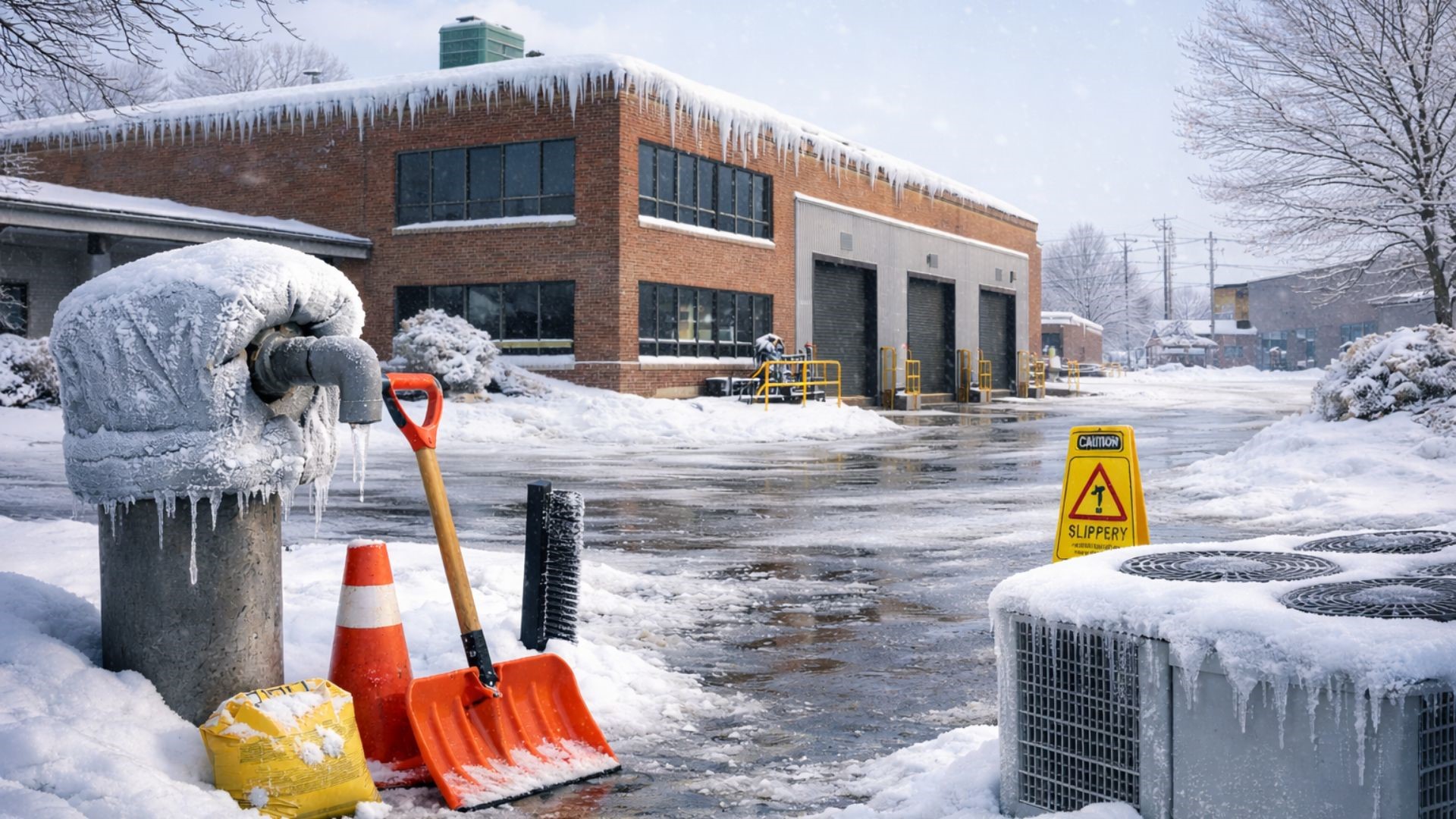
As a Midwest business owner, does your annual plan include commercial property winterization? We’re sure that as soon as the winter hits, every business owner plans for this market shift, inventory management, and staffing. But is your business ready for the extreme seasonal shifts in Ohio, West Virginia, and across the other Midwest regions? These seasonal challenges cause massive inconvenience as well as a direct threat to your operations and assets. A single frozen pipe can flood your whole facility and halt the production process for days. Or worse, imagine an unprepared HVAC system fails during the first deep freeze. Are you ready for that? It can leave employees and customers in the cold and force costly emergency closures.
A commercial property winterization plan helps in systematically protecting your building against the unique threat of the region. The polar vortices can bring sudden and severe temperature drops. The heavy snowfall can damage the roofs, and ice storms can disrupt the power and accessibility.
For seven decades, C&C Wirth Contractors has partnered with local businesses across the Midwest region to help with these essential defenses. Read this blog post to learn about the essential steps of commercial property winterization. Learn how to protect your investment and ensure your business runs smoothly even through the toughest Midwest winter.
For business owners, commercial property winterization should be a calculated investment in your business. It’s not just a precaution; the Midwest climate can present costly risks:
Physical Asset Damage: Burst pipes can cause immense water damage to inventory equipment and building interiors. Ice dams can be a real nightmare and lead to roof leaks and structural compromises.
Operational Downtime: A business facility can not operate properly without heat or water. Without it, there will be closure for repairs, leading to lost revenue, missed deadlines, and dissatisfied customers (yikes). And we don’t want that.
High Energy Costs: Inefficient heating systems, drafty windows, and uninsulated pipes can lead to wasted capital on utility bills.
Safety Liabilities: Icy walkways, parking lots and entryways can create slip-and-fall incidents which will expose your business to major liability.
Implementing a proper commercial property winterization protocol can help reduce or even remove these risks. Upgrading your property from a vulnerable asset to an efficient and safe environment would be good for a change.
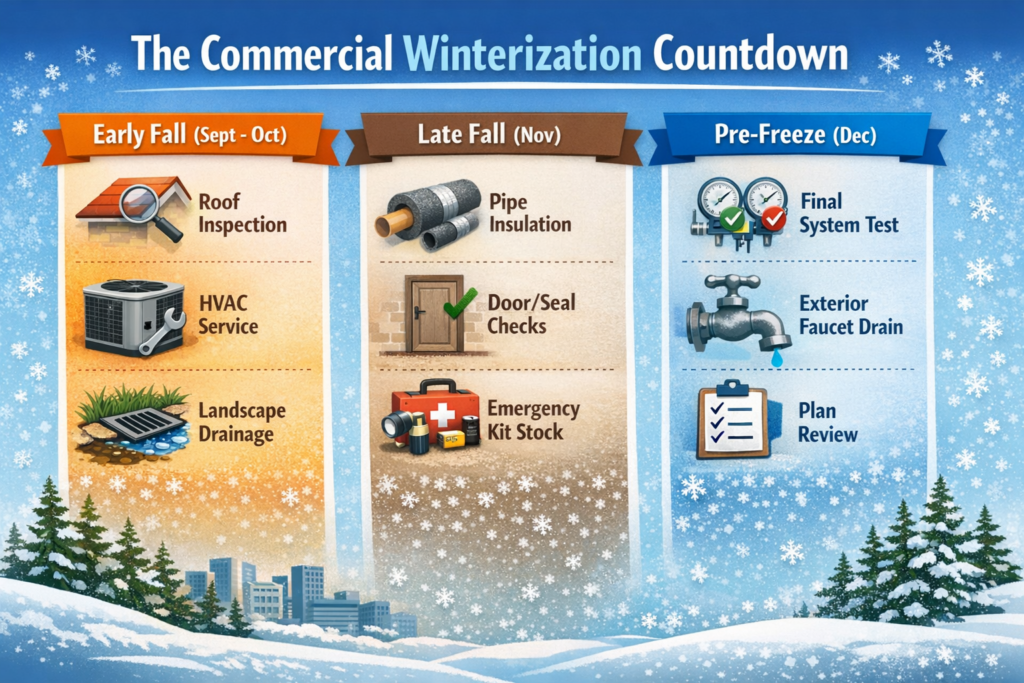
The Commercial Property Winterization Timeline
Plumbing systems are the most vulnerable target in any commercial or residential property, for that matter, especially during winter. When water freezes, it tends to expand, and this pressure has nowhere to go but out. And then?……BOOM….leading to a catastrophic pipe burst that can spill thousands of gallons per hour. One must prioritize their plumbing systems through commercial property winterization.
Here’s a detailed plan of action:
1. Insulate All Vulnerable Piping: This is your first line of defense. First of all, focus on pipes in unheated areas like coral spaces, attics, warehouses and loading docks. Use foam pipe insulation sleeves or heat tape for pipes near exterior walls. You can’t have a good plan to stop pipes from freezing in big buildings without doing this one basic thing first. It is an essential, foundational element before you follow up with your big plan.
2. Drain and Shut Down Exterior Water Sources: Completely disconnect, drain, and store outdoor hoses. Shut off the water supply to exterior faucets and irrigation systems. Now open the outdoor taps to drain any residual water. If you have a very complex irrigation and boiler system, hire professional plumbing service providers to perform a blowout to make sure there’s no remaining water.
3. Maintain a Minimum Temperature: Never let the temperature drop below 55°F (13°C), even in the holidays and weekends. This is a non-negotiable rule if you want to prepare for winter storms. Program your thermostats accordingly and consider installing tamper-proof covers or using a building management system.
4. Locate and Label Main Shut-off Valves: Train your staff well, and every manager and key maintenance staff should know how to shut off the main water valve. If a piper bursts, shutting off the Qatar flow instantly is the only way to minimize the damage. Label all your vessels clearly, especially this one.
5. Professional Inspection: Now and then, hire a licensed commercial plumber to conduct a seasonal inspection, especially in winter. Professionals can identify hidden vulnerabilities. Look for pipes in unexpected exterior chases, and ensure backflow prevention devices are functioning.
The heating system is one of the essential parts of winter’s operations. A failure during a cold snap can shut it down entirely. Commercial HVAC winter maintenance is a technical necessity to ensure reliability and air quality.
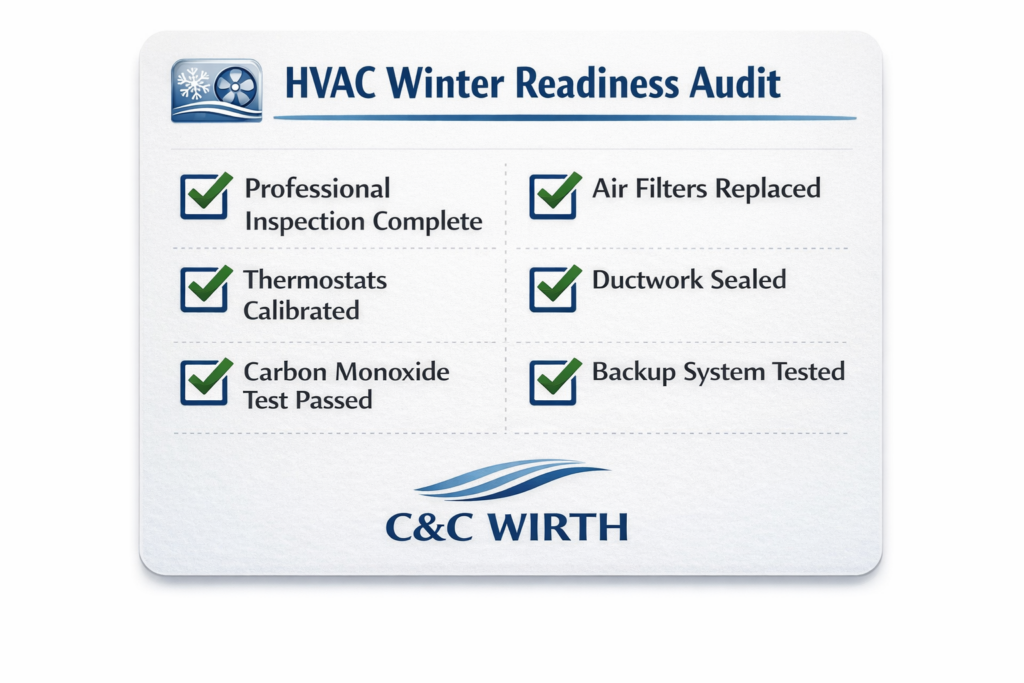
A proper HVAC winterization checklist includes:
A. Professional Furnace/Boiler Inspection: Before the heating season, a professional inspection of the heat exchanger, burners, and ignition system should be performed by a certified technician. They will check for carbon monoxide leaks, test safety devices, and check fuel line integrity. This is a preventative measure that is much less expensive than an emergency service call in January when you have no heat.
B. Thermostat Calibration and Zoning Review: Make sure that thermostats are providing accurate temperature readings. Take a look at your facility’s zoning plan—are areas that are not in use being heated? Adjusting your zoning can provide substantial energy savings.
C. Ductwork Inspection and Sealing: Leaks in ductwork in unheated areas (such as attics) are simply wasting heated air and money. Sealing these leaks will improve system efficiency and provide balanced airflow throughout the facility.
D. Filter Replacement: Clogged filters reduce airflow, causing your system to work harder and potentially overheat and shut down. Replace filters according to the manufacturer’s recommendations, usually more often during peak usage periods.
E. Check Your Backups: If your facility has backup generators or auxiliary heating sources, test them under load before the winter season. It is important to know that your backup will activate in the event of a power outage to provide true storm damage prevention for business.
The “building envelope”; your roof, walls, windows, and doors, is the barrier between your conditioned interior and harsh exterior. A leaky or damaged envelope allows the heat to escape and brings in the moisture. Securing it is an important step in the commercial property winterization process.
Key areas to fortify:
a.) Roof Inspection and Maintenance: Schedule a roof inspection for heavy snow load capacity.
Clear out all drains, scuppers, and gutters of leaves and debris to prevent ice dam formation. Inspect flashing around vents and pipes. Check out the edges for cracks and separation.
b.) Doors and Windows: Check all door sweeps and weatherstripping for wear and tear. If you find any, seal the gaps around window frames with appropriate caulking. Consider installing temporary plastic film insulation kits to reduce drafts for big dock doors or older windows. This keeps the heat in and also stops cold air infiltration that can chill nearby pipes.
c.) Exterior and Grounds: If there are big trees around, then the tree branches hanging over the roof or near power lines. It will prevent snow-load breakage and damage. Seal all the pavement cracks to prevent water infiltration and freezing which leads to potholes. Ensure downspouts direct water at least 5 feet away from the foundation to prevent freezing at the base.
Even with the proper commercial property winterization, severe weather can be hard to handle. Your final step of protection should be strong.
Your emergency plan should include:
I. Updated Contact List: Keep an updated list of emergency contacts for urgent repairs. You can include C&C with Contractors as your emergency partners.
II. Severe Weather Communication Tree: Properly plan how managers will communicate during closures, delays, or emergencies to all staff (e.g., group texts, phone tree, app alert, etc.)
III. On-site Emergency Kits: Stock emergency kits with ice melt, snow shovels, flashlights, batteries, and a first aid kit. And most importantly, make sure all these are accessible to everyone during emergencies.
IV. Vendor Service Agreements: Confirm your snow and ice removal contractor is under contract and knows your property’s priorities (e,g main entrance, loading docks, fire hydrants)
Commercial property winterization is a multi-system, integrated strategy to defend your business against the predictable or unpredictable extreme weather of the Midwest. Look at your property through the lens of risk. Where could cold, wind, ice, and snow hit? And systematically address each vulnerability.
Hire C&C Wirth Contractors for professional assessment and complete commercial property winterization of your business. Contact us today to schedule a consultation and guarantee your business’s safety and continuity all winter long.
A: It’s often a matter of failing to protect the internal plumbing in unused or low-use areas of a facility, such as a rarely used restroom or a janitor’s closet. The plumbing in these areas is just as likely to freeze as the plumbing outdoors if the heat is reduced. A comprehensive winterization service of a commercial property will identify and protect these hidden dangers.
A: Your team is essential for implementation, but a professional has diagnostic skills and can recognize problems in multiple systems. A plumber might recognize a problem with an HVAC system’s condensate line that is in danger of freezing, while an HVAC specialist might recognize a problem with a roof vent that is causing heat loss. The big-picture thinking of a professional commercial property winterization service prevents expensive mistakes.
A: This should be completed before nighttime temperatures begin to regularly drop below freezing. In the Midwest, it is wise to complete this before late October to early November. Waiting until the end to perform commercial property winterization is dangerous, as professionals’ schedules quickly fill, and an early cold snap can leave you caught unprepared.