85 Mansion Blvd Parkersburg, WV 26101
E-mail us: [email protected]
MONDAY-FRIDAY 7AM - 4PM EMERGENSIES BASED ON AVAILABILITY
Follow us:
Page Title BG
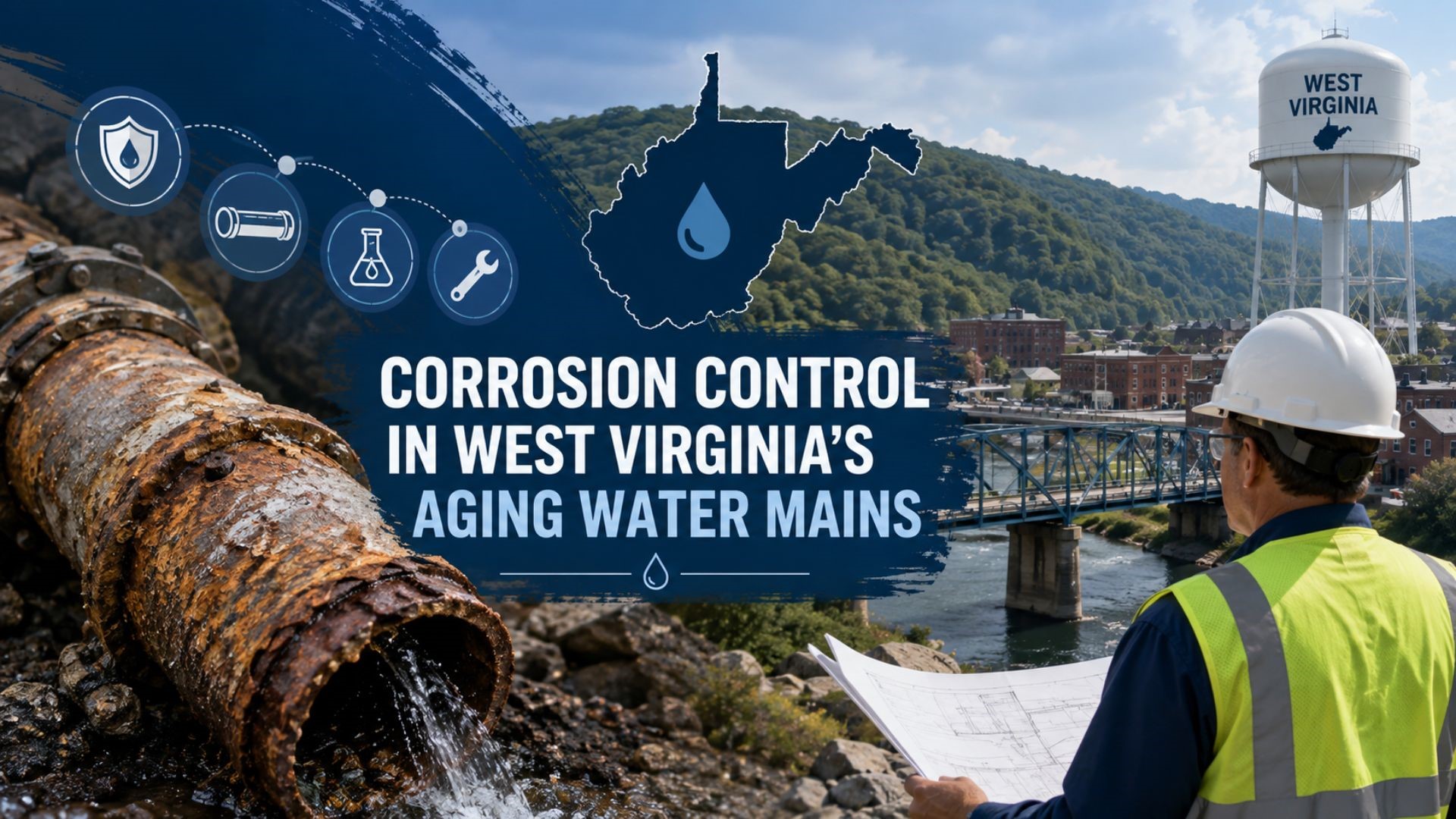
Corrosion Control in West Virginia’s Aging Water Mains: A Guide for Contractors, Engineers, and Municipal Officials

For plumbing professionals and decision-makers in West Virginia, corrosion control in aging water mains is no longer a niche concern; it’s a daily operational reality. Across the Mountain State, decades-old cast iron, steel, and early PVC pipes face aggressive soils, acidic mine-influenced waters, and steep, subsidence-prone terrain that accelerate deterioration. This blog breaks down the technical, regulatory, and practical dimensions of corrosion control in West Virginia plumbing systems, so you can design, specify, and maintain infrastructure that lasts.

Why Corrosion Control Matters More in West Virginia Than Most States

West Virginia’s water infrastructure is among the oldest and most challenged in the U.S. The 2025 ASCE Infrastructure Report Card gave the state’s drinking water a D+, citing aging assets, high water loss, and funding gaps. In coalfield regions, the situation is even more acute: many systems were installed by coal companies in the early 1900s and have crumbled as operators left, leaving communities with unreliable or unsafe tap water.

But beyond age, three state-specific factors make corrosion control in aging water mains critical:

  • Aggressive soils and geology: Acidic, high-sulfur, and moisture-laden soils in much of WV promote external pipe corrosion, especially in uncoated or poorly protected mains.
  • Acid mine drainage (AMD) influence: In southern coalfields, low-pH, metal-laden source waters increase internal corrosion rates and complicate disinfectant stability.
  • Rugged topography and subsidence: Steep gradients, abandoned underground mines, and sinkhole-prone zones impose mechanical stress on joints and pipe walls, exacerbating corrosion-driven failures.

For plumbing contractors, engineers, and municipal officials, ignoring these factors means higher repair costs, more frequent boil-water advisories, and increased liability under state and federal drinking water rules.

The Plumbing and Regulatory Framework

West Virginia’s plumbing and water distribution standards are anchored in the 2015 International Plumbing Code (IPC) and 2015 International Residential Code (IRC), with state amendments that emphasize corrosion-resistant materials and protective measures. Key provisions include:

  • Material standards: Pipe, fittings, and valves must conform to ASTM and AWWA standards and meet ANSI/NSF Standard 61 for health effects.
  • Corrosion-resistant design: State rules explicitly require “special attention” to selecting pipe materials that protect against both internal and external corrosion.
  • External corrosion mitigation: Where soils are found to be aggressive, acceptable actions include polyethylene encasement, cathodic protection, or use of corrosion-resistant materials.
  • Lead control: No pipe or fitting with more than 8% lead content is permitted; lead-tip gaskets are banned.

On the licensing side, SB 839 (2025) redefined “plumbing” work and mandated separate rules for residential vs. commercial plumbing, affecting who can legally perform certain corrosion-control and main-repair tasks. For contractors, this means double-checking scope-of-practice rules before bidding on municipal or utility projects.

How Corrosion Happens in West Virginia Water Mains

Corrosion in WV plumbing systems is rarely a single-mechanism problem. Instead, it’s a combination of chemical, electrochemical, and mechanical factors:

1. External corrosion from aggressive soils

In many WV counties, soils are acidic, conductive, and rich in sulfates, ideal conditions for electrochemical corrosion of buried steel and iron pipes. Without protective coatings or cathodic protection, pipe walls thin, leading to leaks and catastrophic breaks.

2. Internal corrosion from water chemistry

Source waters influenced by AMD or naturally low alkalinity can be corrosive to iron, steel, and even copper. Low pH and high dissolved oxygen accelerate metal dissolution, releasing iron, manganese, and sometimes lead or copper into the distribution system.regulations.

3. Microbiologically influenced corrosion (MIC)

In low-flow, nutrient-rich sections of aging networks, biofilms thrive and create localized corrosion cells under deposits. This is especially problematic in dead-end mains and storage tanks with poor turnover.

4. Stress corrosion and mechanical fatigue

Subsidence from abandoned mines, sinkholes, and seasonal freeze–thaw cycles impose bending and tensile stresses on pipes. When combined with corrosion, these stresses cause crack initiation and rapid propagation, particularly at joints and fittings.

Proven Corrosion-Control Strategies for West Virginia Plumbing Projects

Effective corrosion control in aging water mains in West Virginia requires a layered, site-specific approach. Below are the most relevant strategies for plumbing contractors, engineers, and utility managers.

1. Material selection and upgrades

  • Ductile iron pipe (DIP) with polyethylene encasement: For new and replacement mains in aggressive soils, DIP with V-Bio or conventional poly wrap remains a cost-effective standard.
  • HDPE and fused polyethylene: Highly resistant to both internal and external corrosion, HDPE is increasingly used for small-diameter distribution lines and service connections in coalfield communities.
  • Cement-mortar and epoxy-lined steel: For larger transmission mains, internal linings reduce metal release and extend service life in corrosive waters.

2. External corrosion protection

  • Polyethylene encasement: Wrapping ductile iron and steel pipes in polyethylene sleeves is a minimum requirement in many WV jurisdictions where soils are classified as corrosive.
  • Cathodic protection (CP): In severe cases, galvanic (sacrificial) or impressed current cathodic protection (ICCP) systems are installed to shift corrosion away from the pipe surface. State rules require CP testing by NACE-certified (or equivalent) personnel.
  • Coating systems: Fusion-bonded epoxy (FBE), polyethylene, and other industrial-grade coatings provide durable barriers against soil-side corrosion.

3. Internal corrosion control and water chemistry

  • pH and alkalinity adjustment: Raising pH and adding alkalinity (e.g., with lime or sodium hydroxide) reduces the corrosivity of distribution water and helps form stable protective scales inside pipes.regulations.justia+1
  • Corrosion inhibitors: Orthophosphates and other inhibitors are widely used to form thin, protective films on pipe interiors, reducing lead and copper release under the Lead and Copper Rule.regulations.justia+1
  • Disinfectant management: Optimizing chlorine or chloramine residuals limits biofilm growth and MIC without excessively oxidizing pipe materials.

4. Design and operational practices

  • Joint protection and bonding: In corrosive soils, bonding ductile iron joints and installing test stations allow for monitoring and mitigating stray currents and galvanic effects
  • Pressure and surge control: Reducing excessive pressures and controlling water hammer minimizes stress on corroded sections and extends remaining life.
  • Leak detection and proactive replacement: Acoustic surveys, district metering, and SCADA-based flow monitoring help identify high-corrosion zones before catastrophic failures occur.

Real-World Implications: From Coalfield Boil-Water Advisories to Statewide Upgrades

The human impact of inadequate corrosion control in aging water mains is starkly visible in southern West Virginia. Towns like Keystone and Northfork have lived under boil-water advisories for over a decade due to crumbling, corroded systems originally built by coal companies. Residents report going months without reliable tap water, relying on bottled water and hauled supplies for basic needs.

At the same time, state and utility investments are starting to address these gaps. Recent projects include:

  • Multi-million-dollar water and wastewater upgrades in Kanawha, Tucker, and Barbour counties, including corrosion-resistant pipe replacements and monitoring systems.
  • Over $124 million in 2025 investments by West Virginia American Water for system improvements targeting aging infrastructure and treatment upgrades.
  • New corrosion-protection requirements in state rules that mandate testing, protective coatings, and cathodic protection where soils are aggressive.

For plumbing professionals, these trends signal growing demand for specialists who understand both field-level corrosion mitigation and regulatory compliance.

Practical Checklist for Plumbing Professionals in West Virginia

If you’re bidding on, designing, or maintaining water and sewer projects in WV, use this quick checklist to ensure your corrosion-control strategy is robust and compliant:

  • Verify soil corrosivity classification and design appropriate external protection (poly wrap, coatings, CP).
  • Confirm all pipe, fittings, and valves meet ASTM/AWWA and ANSI/NSF 61 standards; avoid lead-containing components.
  • Coordinate with water treatment operators on pH, alkalinity, and inhibitor dosing to control internal corrosion.
  • For large or critical mains, consider cathodic protection with NACE-certified testing and monitoring.
  • Document compliance with 2015 IPC/IRC and state amendments, especially for municipal and utility work.
  • Factor in SB 839 licensing distinctions when assigning residential vs. commercial plumbing tasks.

Final Words

In West Virginia, effective corrosion control in aging water mains is not just an engineering detail; it’s a public health imperative and a business opportunity. For contractors and engineers who master the interplay of materials, chemistry, geology, and code, there’s a clear path to higher-value projects, fewer callbacks, and stronger community trust.

If you’re planning a specific project, whether a coalfield service-line replacement, a municipal main upgrade, or a new subdivision’s plumbing system, and want help aligning your design with West Virginia’s corrosion-control requirements, a focused conversation with a local corrosion specialist or state regulator can save time, money, and liability down the line.
Share:
Leave a Comment